
Why can heavy rains be a problem when the soil is very dry?
The short answer:
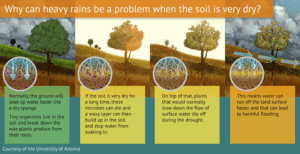
Getting rain after a drought seems like a good way to replenish water supplies, but sometimes when it’s very dry, heavy rains can actually be harmful. In general, when the soil is dry the ground will soak up water faster like a dry sponge under a running faucet. However, if there is a severe drought, the exact opposite happens and you get floods. But why?
There are two reasons. First, if the soil is very dry for a long time, tiny organisms (microorganisms) in the soil can die. These microorganisms normally break down the waxy substances that plants produce from their roots. If the microorganisms die, a waxy layer can build up in the soil and stop water from soaking in. Second, the leaves and branches of living plants provide resistance to water flowing along the surface, slowing it down and letting more water soak into the soil. If they die, they no longer do this.
Without plants above the surface and microorganisms in the soil, more water runs off the ground quickly in a heavy rainstorm. This can cause harmful floods downstream and even carry away some of the bare soil with the flood in a process called erosion.
Media downloads:
| NAME | DESCRIPTION | SIZE | LENGTH |
|---|---|---|---|
| Rain on Dry Soil Animation (zip) | Video with no voiceover or captions plus sample script | 65 MB | 40s |
Design team:
Student Developers:
Roberta Garcia, Sabrina Rayner, and Danielle Tadych
Translators:
Jaritza Gómez, Xenia De Gracia, and Luz Yaretzi García Ramírez
Advisors:
Project Manager: Sara Kobilka
Science Advisor: Laura Condon
Graphic Designer:
Megan Roxbury
Infographic:
(click image to enlarge)
On Social Media:
Video Source:
References and Additional Resources:
To learn more about this question checkout these resources:
- Chandler, David. “Explained: Hydrophobic and Hydrophilic.” MIT News, Massachusetts Institute of Technology, 16 July 2013
- Crump, Wesley. “Do Droughts Make Floods Worse?” Practical Engineering, Practical Engineering, 05 Sept. 2023
- “Hydrophobic Soil.” Wikipedia, Wikimedia Foundation
- “Hydrophobic Soil: Treatment and Prevention.” TheSeedCollection, 10 Dec. 2022
- U.S. Department of Agriculture, Natural Resources Conservation Service. “Soil Quality Indicators: Infiltration.“, June 2008 (PDF)
Por qué las lluvias intensas pueden ser un problema cuando la tierra está muy seca?
La respuesta corta:
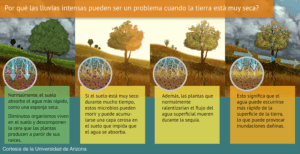
Recibir lluvia luego de una sequía parecerá un buen método de reponer suministros de agua, pero a veces cuando es muy seco, lluvias altas pueden ser nocivas. En general cuando el suelo está seco la tierra absorbe agua rápido, como una esponja seca bajo un grifo. Sin embargo, si hay una sequía extrema pasa lo opuesto y hay inundaciones. Pero, ¿por qué?
Existen dos razones. La primera es que si el suelo está seco por mucho tiempo, organismos pequeños (microorganismos) en el suelo pueden morir. Estos microorganismos normalmente descomponen sustancias de cera que las plantas producen en sus raíces. Si los microorganismos mueren la capa de cera puede aumentar en el suelo y prevenir la absorción del agua. Segundo, las hojas y ramas de las plantas vivas proveen resistencia al flujo de agua en la superficie, reduciéndolo y dejando más agua empapara la superficie. Si las plantas mueren no pueden hacer esto.
Sin plantas sobre la superficie y microorganismos en el suelo el agua fluye de la tierra más rápido. Esto puede causar inundaciones peligrosas río abajo y hasta arrastrar parte del suelo con la inundación en un proceso llamado erosión.
Materiales disponibles para descarga:
| TÍTULO | DESCRIPCIÓN | TAMAÑO | DURACIÓN |
|---|---|---|---|
| Rain on Dry Soil Animation Español (zip) | Video sin voz y sin subtítulos | 61 MB | 40s |
El equipo de Diseño:
Estudiante Desarrolladores:
Roberta Garcia, Sabrina Rayner, and Danielle Tadych
Traductas:
Jaritza Gómez, Xenia De Gracia, and Luz Yaretzi García Ramírez
Consejeros:
La Manejada del Projecto: Sara Kobilka
Asesa Científica: Laura Condon
Diseñador Gráfico:
Megan Roxbury
Infografía:
(haga clic en la imagen para ampliar)
Referencias y recursos adicionales:
Para obtener más información sobre esta pregunta, consulta estos recursos:
- Chandler, David. “Explained: Hydrophobic and Hydrophilic.” MIT News, Massachusetts Institute of Technology, 16 July 2013
- Crump, Wesley. “Do Droughts Make Floods Worse?” Practical Engineering, Practical Engineering, 05 Sept. 2023
- “Hydrophobic Soil.” Wikipedia, Wikimedia Foundation, 22 May 2025
- “Hydrophobic Soil: Treatment and Prevention.” TheSeedCollection, 10 Dec. 2022
- U.S. Department of Agriculture, Natural Resources Conservation Service. “Soil Quality Indicators: Infiltration.“, June 2008 (PDF)